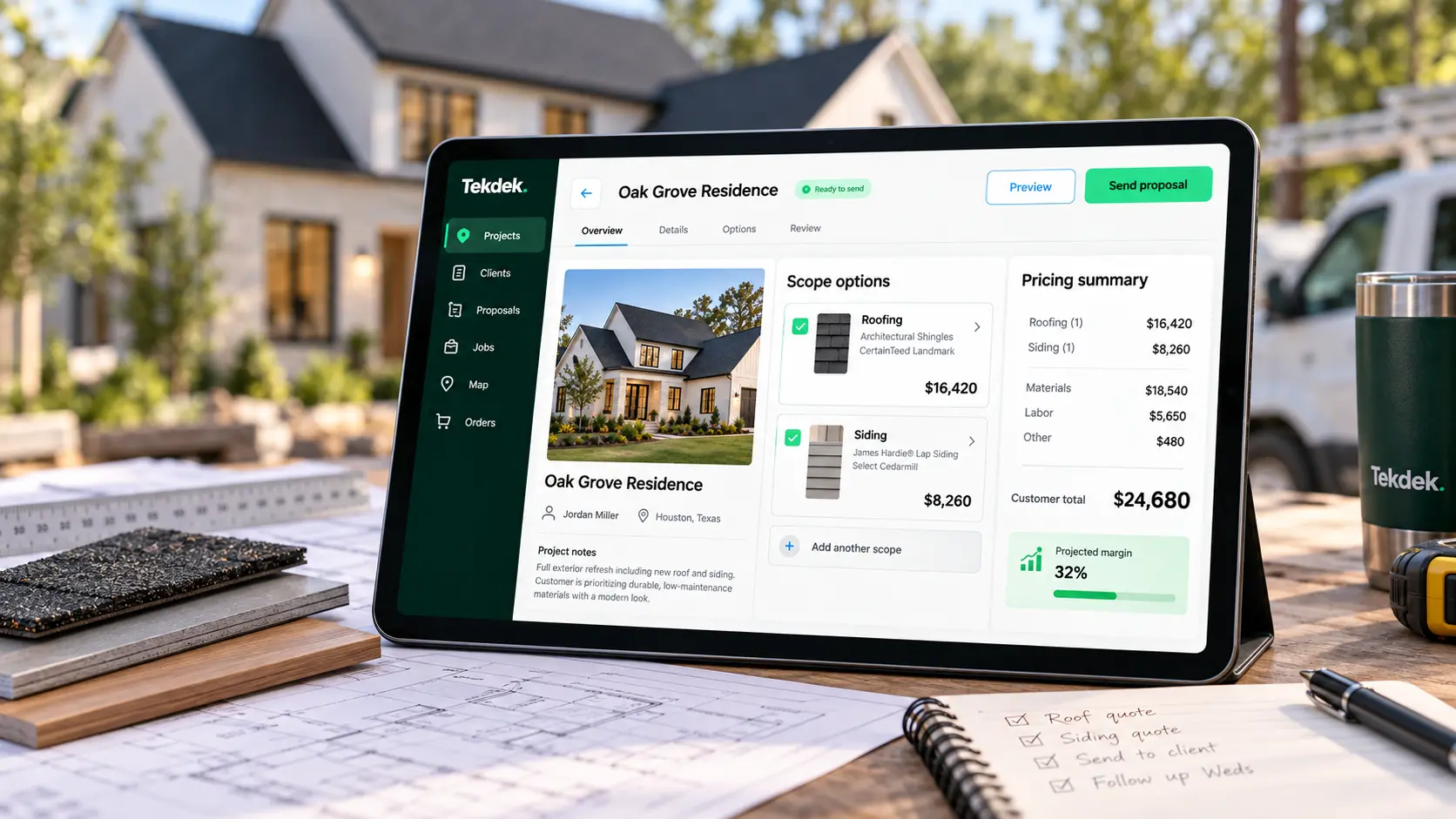
Most contractors treat the quote as a sales document. It is more consequential than that. Long before materials arrive or a crew steps onto the property, the quote has already made decisions about scope, products, quantities, labor, margin, and customer expectations.
If those decisions are clear and connected, production starts with a plan. If they are vague, production starts with questions.
A quote does not merely describe the job. It creates the job.
The moment a rep selects a system, adds an accessory, chooses a waste factor, or leaves a line item out, the downstream work changes. That decision can affect the supplier order, the crew’s sequence, the installation details, the homeowner’s expectations, and the final gross margin.
That is why a fast quote is only useful when it is also buildable. Speed matters, but speed without structure simply moves uncertainty downstream.
Production problems often begin as quoting problems
When a job is short on flashing, trim, starter, fasteners, or a product-specific accessory, the visible problem appears in production. The root cause may have happened days or weeks earlier, when the quote was assembled.
The same is true when the customer expects something the crew did not plan to install. A vague proposal leaves room for assumptions. Production then has to reconcile what the rep intended, what the customer believed, and what the material order actually supports.
Those gaps create familiar costs:
- Emergency material runs and delivery delays
- Rework, change orders, and margin erosion
- Extra calls between sales, operations, and the supplier
- Confusion for the crew and a weaker homeowner experience
- Job-cost reports that explain the loss after it is too late
The handoff should begin inside the quote
A strong workflow does not ask production to rebuild the salesperson’s work. It carries the important decisions forward: measured quantities, selected products, approved options, supplier pricing, and the material list tied to the sold scope.
That connection changes the handoff from “Here is what we sold—figure out what we need” to “Here is the approved scope and the material plan behind it.”
Consistency is not the same as rigidity
Contractors sometimes resist structured quoting because every project is different. That is exactly why structure matters. A repeatable framework does not remove judgment; it gives the rep a reliable place to apply it.
The best systems guide people through the components that should be considered while still allowing an experienced estimator to adjust for the property, product, and installation. That helps a newer rep produce a more complete quote without forcing the veteran to work like a beginner.
The proposal is where operational discipline becomes visible
Homeowners do not see the internal assembly logic or supplier codes. They see the proposal. A clear proposal turns operational discipline into buyer confidence: the scope is understandable, the options are intentional, and the price feels connected to a real plan.
That does not mean exposing every internal cost. It means making the customer-facing offer precise enough that sales and production are working from the same promise.
Measure the quote by what happens after it is signed
Quote speed and close rate matter, but they are incomplete on their own. A healthier scorecard also asks:
- How often does production need clarification?
- How many jobs require an unplanned material run?
- How closely does projected cost match actual cost?
- How often does the sold scope change after handoff?
- Can another team member explain how the quote was built?
A quote that closes quickly but creates avoidable field costs is not truly efficient. The better quote is the one that helps win the job and gives the company a cleaner path to deliver it.
The first production meeting happens before the sale
It happens quietly, inside the quote. Every product choice, quantity, option, and exclusion is an operational decision waiting to become real.
Exterior contractors do not need another isolated document generator. They need a quoting process that connects the promise made in the living room to the materials ordered and the work performed at the house.
That is the standard: not just a quote that looks professional, but a quote the rest of the company can build from.